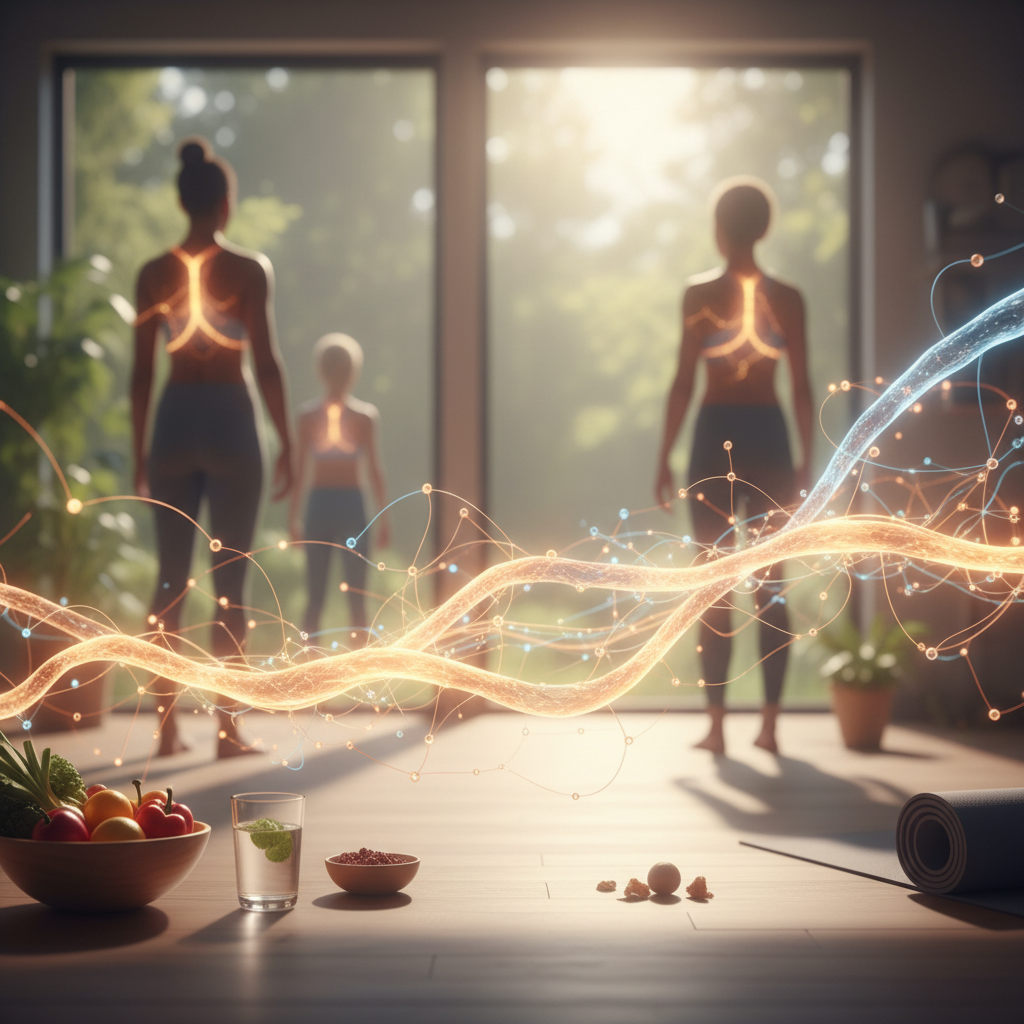

What if the story of what happened to you isn't only living in your memory — but in the tension of your shoulders, the tightness in your throat, the way you flinch before you even know why?
For decades, trauma was treated as a problem of the mind. A narrative to be rewritten. A thought pattern to be corrected. And while the mind matters deeply, there is a quieter, older intelligence that holds what the mind cannot always reach — the body itself.
This is the terrain that psychiatrist and researcher Bessel van der Kolk has spent over forty years mapping. And what he found changed everything.
The Body Keeps the Score
In 1994, van der Kolk published a landmark paper. In 2014, he released the book that would bring his life's work to millions: The Body Keeps the Score: Brain, Mind, and Body in the Healing of Trauma. The title alone is a revelation.
Trauma, van der Kolk argues, is not simply a memory. It is a physiological imprint. When something overwhelming happens — something the nervous system cannot fully process and integrate — the body freezes that moment in place. Not metaphorically. Literally. The muscles contract. The breath shortens. The stress hormones flood and, in some cases, never fully recede.
"Trauma is not just an event that took place sometime in the past; it is also the imprint left by that experience on mind, brain, and body."
— Bessel van der Kolk, The Body Keeps the Score
Using brain imaging studies, van der Kolk and his colleagues observed that during trauma recall, the speech center of the brain — Broca's area — goes offline. The person becomes, quite literally, speechless. Meanwhile, the limbic system, the brain's emotional and survival center, lights up as if the threat is happening right now.
This is why talk therapy alone so often reaches its limits. You can describe what happened. But the body is still bracing for impact.
What the Nervous System Remembers
At the heart of van der Kolk's work is a deep respect for the body's survival intelligence. The nervous system is not broken when it holds trauma. It is doing exactly what it was designed to do — protect you. The problem arises when that protection never gets the signal that the danger has passed.
This is what trauma researchers call dysregulation — a nervous system stuck in cycles of fight, flight, or freeze, long after the original threat is gone. You might recognize it as the hypervigilance that keeps you scanning a room. The numbness that descends when emotions get too close. The inexplicable physical symptoms — chronic pain, digestive disruption, fatigue — that no scan or blood test seems to explain.
Van der Kolk's work draws on the foundational research of Stephen Porges and Polyvagal Theory, which describes how the vagus nerve — a vast network threading through heart, lungs, and gut — acts as a continuous broadcast system between body and brain. Safety is not just a thought. It is a felt sense. And healing, therefore, must be felt too.
Pathways Back to the Body
This understanding opens something profound: if trauma lives in the body, then healing must involve the body. Not only the story. Not only the insight. But the breath, the movement, the sensation, the presence.
Van der Kolk has championed several somatic and embodied approaches to trauma healing:
- EMDR (Eye Movement Desensitization and Reprocessing) — a structured therapy that uses bilateral stimulation to help the brain reprocess traumatic memories. Learn more at the EMDR Institute.
- Somatic Experiencing — developed by Peter Levine, this approach works with the body's incomplete survival responses, gently allowing trapped energy to complete and release.
- Yoga and mindful movement — van der Kolk ran clinical trials showing that trauma-sensitive yoga significantly reduced PTSD symptoms, particularly in women for whom talk therapy had not been enough. The practice of returning awareness to the body — breath by breath, movement by movement — begins to restore a sense of inner safety.
- Theatre, rhythm, and creative expression — van der Kolk has long championed the role of art, music, and collective rhythm in trauma recovery, recognizing that the body heals in community and in creativity, not only in clinical settings.
- Neurofeedback — a method of retraining brainwave patterns, offering the nervous system a direct experience of regulation.
What unites all of these pathways is a single orientation: presence over analysis. Rather than asking why something happened, the invitation is to notice what is happening — right here, in this breath, in this body, in this moment.
Awareness as the First Act of Healing
Van der Kolk writes that one of the greatest gifts you can give a traumatized person is to help them feel what they feel without being overwhelmed by it. This is the essence of what mindfulness researchers call interoception — the capacity to sense your own interior landscape.
Neuroscience confirms that practices which cultivate interoceptive awareness — breath-focused meditation, body scans, slow mindful movement — actually thicken the insula, the region of the brain involved in self-awareness and emotional regulation. Research published in NeuroReport found that long-term meditators showed increased cortical thickness in regions associated with attention and interoception.
This is not mysticism. This is biology catching up with ancient wisdom.
The body has always known the way home. The practice — and it is a practice — is learning to listen again. To soften the vigilance long enough to feel the stillness that was always there beneath the noise. To witness yourself not with judgment, but with the same quiet compassion you might offer a child who has carried something far too heavy for far too long.
Because that is, in many ways, exactly what healing is. Not fixing what was broken. But finally — gently — setting down what was never yours to carry alone.
A Gentle Invitation
Before you move on, take one breath. A real one. Let it drop all the way into your belly. Notice where you feel it. Notice where you don't. There is no right answer. Only awareness. And awareness, as van der Kolk has spent a lifetime showing us, is where everything begins.
Where in your body do you notice you've been holding something? What might it feel like to simply witness that — without needing to fix it today?