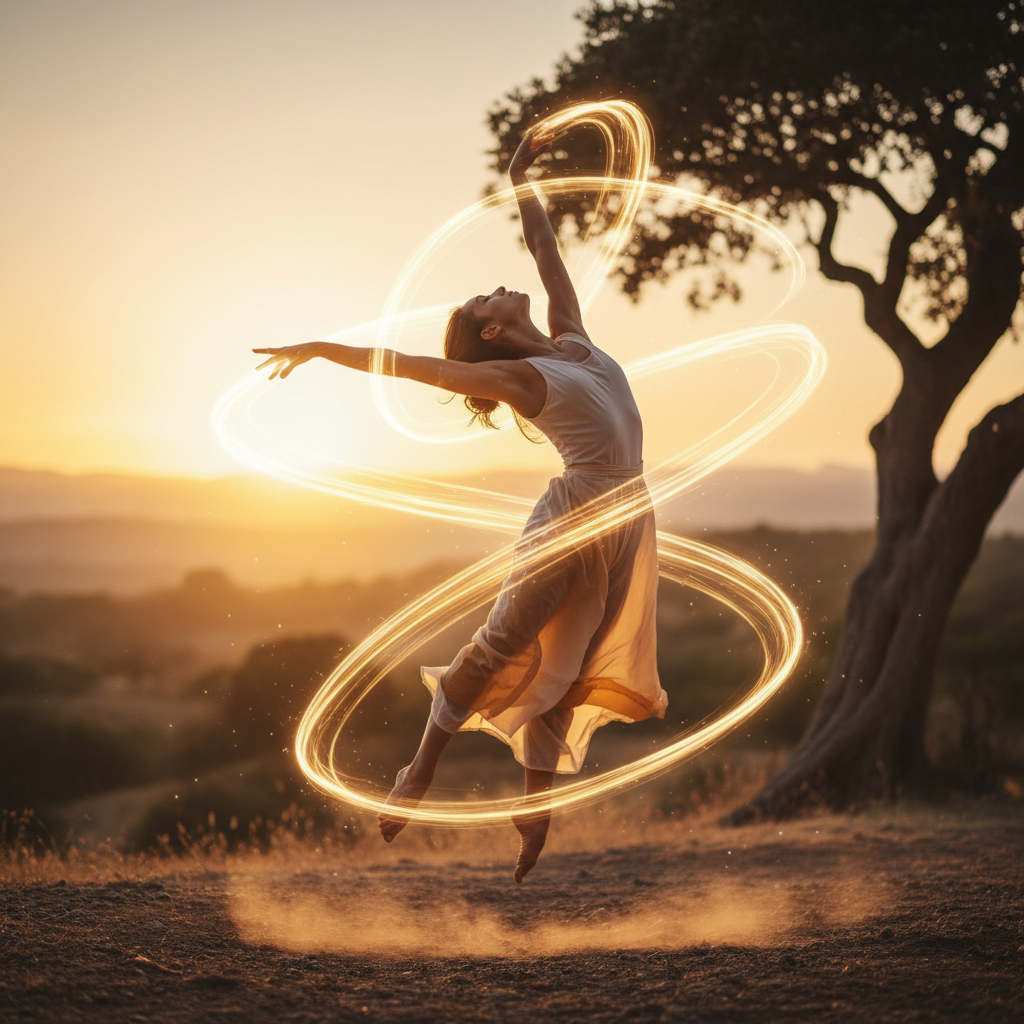
What if your body already knows the way back to itself — and it's been waiting, all this time, for you to let it move?
Not choreographed. Not performed. Not judged. Just moved.
There is something ancient and immediate about dance. Before language, before ritual formalized into doctrine, before we had words for grief or joy or belonging — we had the body. We had rhythm. We had the instinct to respond to life through movement. Dance is not a trend, a fitness format, or an artistic discipline alone. It is one of the oldest technologies of the human nervous system. A way of processing what words cannot hold.
This is an invitation to remember that.
---The Body Keeps the Score — and the Song
Modern science is catching up to what traditional cultures have always known: the body is not a vehicle for the mind. It is a complete intelligence in its own right. And it stores everything.
Stress, grief, trauma, unexpressed emotion — these do not simply vanish when we "move on." They settle into tissue, breath patterns, posture, the chronic tightness between shoulder blades that no amount of stretching seems to reach. Dr. Bessel van der Kolk's landmark research has shown that trauma lives in the body and requires somatic — body-based — approaches to truly integrate and release.
Dance is one of those approaches. When we move with intention and freedom, we activate the parasympathetic nervous system — the branch responsible for rest, digestion, and felt safety. Rhythmic, expressive movement has been shown to reduce cortisol, regulate the limbic system (our emotional processing center), and generate neurochemical states associated with connection and pleasure, including dopamine, serotonin, and oxytocin.
A 2019 study published in Frontiers in Psychology found that dance/movement therapy significantly reduced symptoms of depression and anxiety, while improving body image and self-esteem. Not because it "fixed" anything — but because it created the conditions for the body to speak, and the self to listen.
"The body is the shore on the ocean of being."
— Rumi
When you dance — freely, without a mirror or a grade — you are not performing. You are communing with the deeper intelligence of your own aliveness.
---Dance as Nervous System Reset
Think about the last time you danced — really danced, without self-consciousness. What happened in your body afterward?
Probably: softening. A kind of warmth. Breath that came more easily. A quiet that felt different from exhaustion.
That is your nervous system regulating. Movement — especially rhythmic, bilateral movement where the body crosses its own midline — has been studied extensively in somatic trauma work. It activates both hemispheres of the brain, supports integration between the thinking mind and the feeling body, and discharges the stored arousal that accumulates from modern life's relentless low-grade stress.
Practices like 5Rhythms — developed by Gabrielle Roth — were built specifically on this understanding. The five rhythms (Flowing, Staccato, Chaos, Lyrical, Stillness) map onto states of the nervous system and guide the mover through a full arc of emotional and physiological release. Thousands of people have used these practices not as dance classes but as healing containers.
You do not need a studio or a method, though. You need music that moves you, a few square feet of space, and the willingness to let your body lead — even for five minutes. Especially for five minutes.
---Celebration, Prayer, Creativity — All at Once
Across every culture on earth, dance has served as prayer. In Sufi tradition, the whirling of the dervish is not spectacle — it is a turning toward the divine, a dissolution of the small self into something larger. In West African ceremonial dance, movement is how the community calls in spirit, honors ancestors, and acknowledges the sacred within the embodied. In Balinese temple dance, every gesture is a precise language of devotion.
Dance, at its most essential, is a conversation between the self and the cosmos.
Even in its most secular, contemporary form — dancing alone in your kitchen at 11pm to a song that breaks you open — something sacred is happening. You are saying: I am here. I am alive. I am feeling this. That is a form of prayer. That is presence.
It is also creativity. When the body moves without a script, it discovers things the mind would never have generated. Improvisation — in dance as in jazz — is a practice of radical presence. You cannot plan it. You can only respond, flow, attune. In this way, dance trains the same capacities that sustain a creative, connected life: listening, adaptability, trust, and the courage to express what is real.
---Reconnecting with the Body as Home
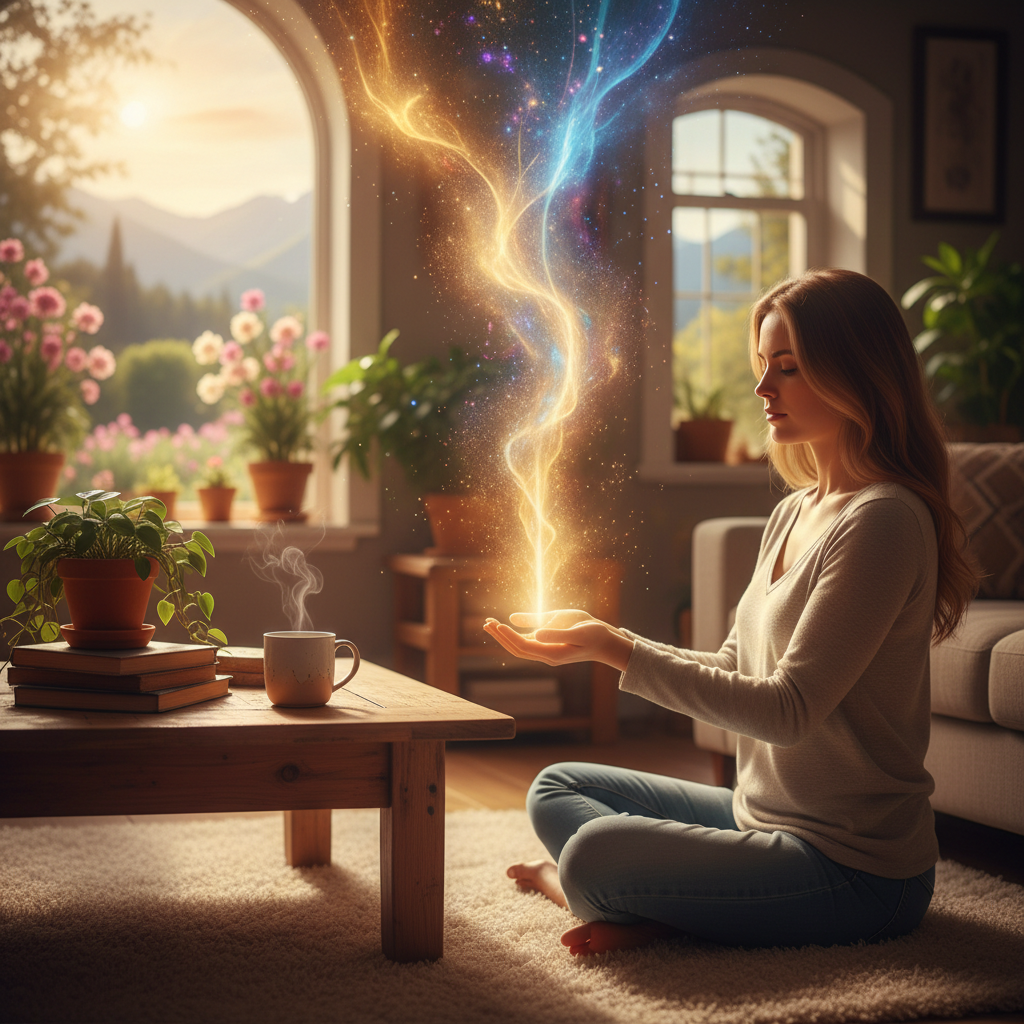
Many of us have learned, subtly and over many years, to live above the neck. We analyze, plan, scroll, produce. The body becomes a transportation system for the mind — fed, exercised, maintained — but not truly inhabited.
Dance is one of the most direct paths back to embodied presence. Not because it is dramatic or demanding, but because it asks you to feel yourself from the inside.
This is what Embodied Truth — one of VIBEUP's core values — points toward: the understanding that your body is not a problem to manage or a shape to perfect. It is a living, breathing field of awareness. It knows things. It carries wisdom. It holds your history and your capacity for joy in the same tissue.
When you dance, you are practicing coming home. You are choosing to be present with yourself — not as an idea, but as a felt, moving, breathing being.
Somatic Experiencing, developed by Dr. Peter Levine, and related body-centered modalities increasingly point to expressive movement as a key component of restoring the felt sense of safety in the body. Safety that allows expansion — emotionally, relationally, spiritually.
---A Gentle Invitation
You don't need to be a dancer. You need to be willing.
Willing to close the door, choose a song that lives somewhere deep in you, and let your body decide what it needs to do next. Let it be clumsy. Let it be slow. Let it surprise you.
Notice what arises. Where does movement want to begin — the hips, the shoulders, the hands? Where does it feel held? What emotion surfaces if you follow the impulse all the way through instead of stopping it?
Dance is not about expression for an audience. It is about integration for a self. It is the practice of allowing the outer body to move in harmony with the inner life — which is, at its heart, the entire project of conscious living.
So: what would it feel like to let your body lead — even just once today?
Put something on. Close your eyes. Take one breath. And begin.
---Further Exploration
- The Body Keeps the Score — Dr. Bessel van der Kolk — Foundational research on how the body stores trauma and the role of somatic practices in healing.
- 5Rhythms — Gabrielle Roth's movement practice — A global community and framework for using dance as a path to self-awareness and liberation.
- Dance/Movement Therapy and Its Effects on Mental Health — Frontiers in Psychology, 2019 — Peer-reviewed research on dance as a therapeutic modality for depression, anxiety, and body image.