What if the most important signal your content ever sends isn't measured by an algorithm at all?
Pause for a moment. Think about the last piece of content that genuinely moved you — a post, an essay, a video that made you stop scrolling and actually breathe. Did you notice how many followers the creator had? Did you check the like count before allowing yourself to feel something?
Probably not.
Something landed. Something resonated. And no number captured that.
We are living inside one of the most profound tensions of the digital age: a system built entirely around popularity — and a growing, quiet hunger for something it cannot measure. That hunger has a name. It's called resonance. And learning to follow it — in how we create, consume, and connect online — may be one of the most grounding acts of digital self-awareness available to us right now.
The Popularity Trap: When the Metric Becomes the Message
The modern internet was not designed around meaning. It was designed around attention — and attention, it turned out, could be quantified, packaged, and sold.
Follower counts. Like ratios. Reach. Impressions. Virality scores. These metrics didn't just describe behavior — they began to shape it. Creators started producing content for the algorithm rather than for the person on the other side of the screen. Audiences began unconsciously using social proof as a proxy for value: If this many people liked it, it must be worth something.
Research from MIT Media Lab has explored how engagement metrics create feedback loops that amplify emotionally charged content — often outrage, fear, or novelty — over nuanced, slower, more nourishing material. The algorithm doesn't reward depth. It rewards reaction.
And so we find ourselves in a strange paradox: more connected than any generation in human history, yet more people report feeling unseen, unheard, and misaligned with what they consume and create online.
"We are drowning in information, while starving for wisdom."
— E.O. Wilson, biologist and author of Consilience
The cost isn't just creative. It's internal. When we calibrate our worth — as creators or as humans — to numbers that fluctuate with trends, we hand our inner compass to a machine that does not know us, does not care for us, and is optimizing for something entirely different from our flourishing.
What Resonance Actually Is — and Why It Matters More
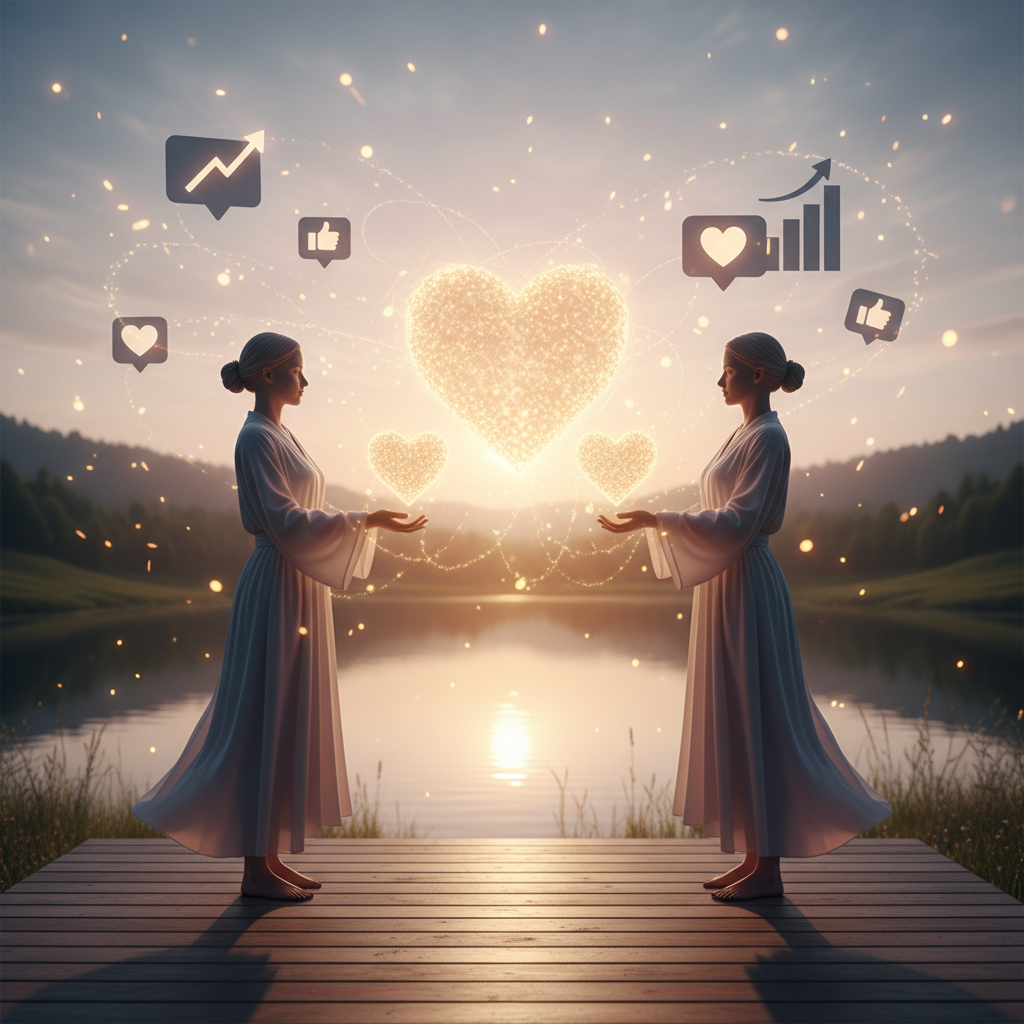
Resonance is not popularity's quieter cousin. It is an entirely different phenomenon.
In physics, resonance occurs when one system vibrates in harmony with another — amplifying energy rather than merely transferring it. In human experience, resonance is that feeling of yes, exactly that — when something someone says or creates matches something true inside you that you hadn't yet found words for.
It's embodied. It moves through the nervous system, not just the mind.
Neuroscientist Dr. Dan Siegel, whose work on interpersonal neurobiology has influenced both psychology and mindfulness communities, describes resonance as the felt sense of being truly seen — a state in which another person's inner world is received and reflected back. This, he argues, is foundational to healing, to trust, and to genuine human development.
When content resonates, something similar happens — even across a screen. The reader feels recognized. Not performed at. Not sold to. Met.
This is why a newsletter with 400 deeply engaged subscribers can create more real-world change, more genuine community, and more lasting meaning than a viral post seen by 4 million. The numbers don't tell that story. But the people living it feel it completely.
Resonance Metrics: A New Internal Compass
So what would it look like to orient our digital lives around resonance rather than popularity? Not as a romantic ideal — but as a practical, embodied shift in how we pay attention?
It begins internally, in the Internal Self dimension — in the thoughts, emotional responses, and quiet signals we've been trained to override in favor of external validation.
Consider these as resonance signals worth tracking:
- Did this piece of content create stillness or agitation in me? Not whether it excited you, but whether it grounded you.
- Did it expand my thinking or collapse it into reaction? Genuine resonance opens something. Reactive content closes.
- Do I feel more like myself after engaging — or more scattered? This is embodied data. Your nervous system knows.
- Am I creating from fullness or from fear? Fear-driven creation chases metrics. Fullness-driven creation trusts its audience.
- Is someone responding to me or to a performance of me? Real resonance requires real presence. Anything less is echo.
Researchers studying awe and meaningful experience at UC Berkeley's Greater Good Science Center have found that experiences perceived as deeply meaningful — including certain forms of storytelling and artistic expression — activate distinct neural pathways associated with connection, self-transcendence, and prosocial behavior. Meaning, in other words, leaves a different mark on the brain than virality does.
Popularity activates the reward center. Resonance activates integration.
The Quiet Revolution Already Underway
There is a movement happening — not loudly, not virally, but meaningfully. Creators are leaving follower-count-obsessed platforms for smaller, slower, more intimate ones. Writers are choosing newsletters over feeds. Podcasters are building listening communities rather than download empires. Artists are finding that their most aligned work reaches fewer people — and changes them more completely.
This is the beginning of a shift from broadcast culture to resonance culture.
Platforms like Substack have grown precisely because they offer something the attention economy doesn't: a direct, unmediated relationship between creator and reader — no algorithmic filter, no like button, no viral amplification. Just words, and the people willing to show up for them, repeatedly, because something there is genuinely worth returning to.
This is Purposeful Presence in digital form. Not performing for an audience. Existing with one.
And as a consumer, the revolution is just as available to you. You don't have to wait for platforms to change. You can begin today by asking yourself one simple question before you scroll: What am I actually here to feel? That question alone realigns the entire experience — from passive consumption to intentional attunement.
A Closing Reflection
We are, collectively, in what feels like an Awakening moment with technology. The initial rush of the digital age — its speed, its reach, its addictive brilliance — is beginning to reveal its shadow. And from that shadow, something new is asking to be born.
Not a rejection of technology. A maturation of our relationship with it.
The shift from popularity metrics to resonance metrics is, at its core, an internal one. It asks you to trust your own felt sense over the crowd's consensus. To value depth over reach. To create and consume from a place of alignment rather than anxiety.
It asks you — gently — to come back to yourself first.
Your attention is not just a commodity. It is a form of sacred sovereignty. Where you place it shapes who you become. And the content that truly deserves it will not be the loudest signal in the room. It will be the one that makes you feel, quietly, completely, unmistakably — seen.
Invitation to sit with: The next time you finish reading, watching, or creating something online — before you check the metrics, before you reach for the next thing — place one hand on your chest and simply ask: Did that land? Did it open something in me, or close it? Let your body answer before your mind does.
Further Exploration
- Dr. Dan Siegel on Interpersonal Neurobiology and Resonance — foundational research on how resonance operates in the nervous system and relationships
- Greater Good Science Center: How Awe Transforms the Body and Mind — Berkeley research on the neuroscience of meaningful experience versus reactive engagement
- Cal Newport's Digital Minimalism — a grounded, research-backed exploration of reclaiming intentional attention in a distracted world