
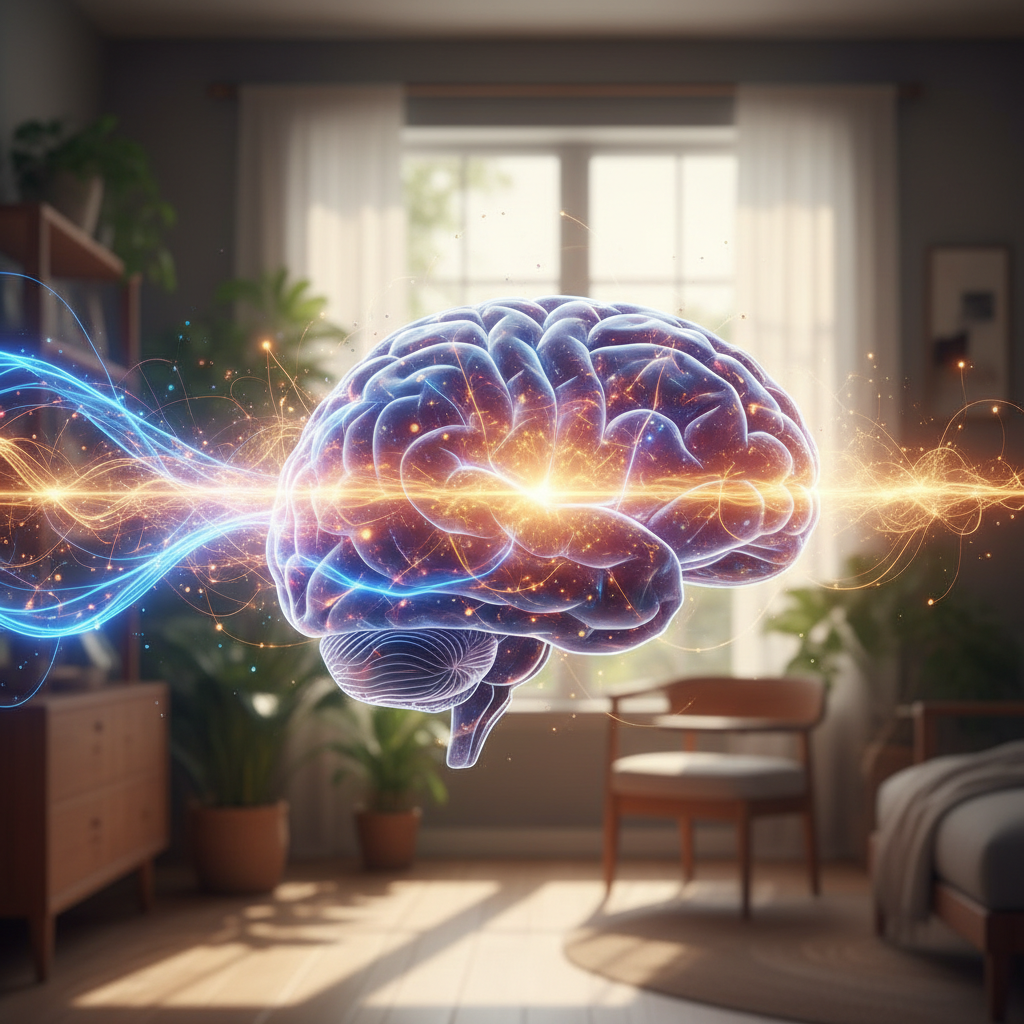
What if the most important question isn't what AI can do — but what it's quietly doing to you?
Not in a fearful way. In an honest, eyes-open, let's actually look at this way.
We are living inside one of the most significant cognitive shifts in human history. Artificial intelligence is reshaping how we search, how we decide, how we create — and beneath all of that, how we think. Not just what we think about. The very texture and rhythm of thought itself.
This isn't a warning. It's an invitation to bring awareness to something that's already happening — so that you remain the author of your inner world, not just a reader of someone else's algorithm.
The Quiet Rewiring
The brain is not fixed. You probably know this — neuroplasticity, the remarkable truth that our neural pathways reshape themselves in response to experience, is now foundational neuroscience. What we do repeatedly, we become. What we attend to, we strengthen.
And right now, millions of us are attending to AI — constantly, casually, reflexively.
We ask it before we wonder. We receive its answers before we sit with our questions. We let it draft our words before we feel what we actually want to say.
Researchers at MIT Media Lab and cognitive scientists studying extended mind theory suggest that when we outsource cognitive tasks consistently, we don't just save mental energy — we gradually reduce our capacity for those tasks. The neural pathways that support deep reasoning, creative synthesis, and sitting with uncertainty begin to thin from disuse.
"The medium is the message. The medium shapes and controls the scale and form of human association and action."
— Marshall McLuhan, Understanding Media (1964)
McLuhan saw this before screens were even personal. Every technology we adopt doesn't just extend our reach — it reshapes the reach itself. The question is: are we reshaping toward who we want to become?
What Surrendering Your Thinking Actually Costs
There's a concept worth sitting with: cognitive offloading. It's what happens when we use external tools — notebooks, GPS, search engines, now AI — to carry mental tasks we once held internally.
Some offloading is genuinely freeing. Writing things down so you don't have to memorize them? Beautiful. That's using a tool with intention.
But there's a subtler kind of offloading happening now — one that touches not just memory or logistics, but meaning-making. When AI writes your reflection, summarizes your complexity, finishes your sentence before you feel it — something shifts. You begin to relate to your own inner life at one remove.
A 2023 study published in Nature Human Behaviour found that heavy reliance on algorithmic recommendations correlated with reduced confidence in personal judgment and a narrowing of exploratory thinking. We don't just get lazier — we get smaller.
In VIBEUP's framework, this lives in the dimension of the Internal Self — that tender, sovereign space of your thoughts, your emotions, your spirit. Sacred Sovereignty isn't a mystical concept here. It's the lived, grounded practice of remaining the primary inhabitant of your own mind.
Thinking With AI — Not Thinking Instead of Yourself
Here's where the conversation softens and opens.
AI is not the enemy of consciousness. Fire wasn't the enemy of warmth. The press wasn't the enemy of wisdom. Every tool carries potential for both expansion and contraction — and the difference almost always comes down to intention and awareness.
Used consciously, AI can be a remarkable thinking partner. It can help you surface ideas you hadn't considered, challenge assumptions you've held too tightly, or illuminate patterns in information that would take weeks to find alone. Researchers at Stanford Human-Centered AI Institute are actively exploring frameworks for what they call "collaborative intelligence" — human and machine thinking together in ways that amplify rather than replace human depth.
The key distinction is this: are you bringing yourself to the interaction — your wonder, your discernment, your felt sense — or are you arriving empty, waiting to be filled?
One is integration. One is dissolution.
Practices for Staying Sovereign in an AI World
Staying grounded in your own thinking isn't about rejecting technology. It's about returning to yourself first — and reaching for the tool second. A few practices that support this:
- Wonder before you ask. Before opening AI, sit with your question for even two minutes. What do you think? What do you feel? Let your inner landscape respond first.
- Write to think, not to produce. Keep a private journal that AI never sees. Messy, unpolished, yours. This is where your real cognition lives and breathes.
- Audit your reliance. Once a week, notice: where did I let AI think for me today? Not with judgment — with curiosity. Awareness is always the first move.
- Disagree with it sometimes. When AI gives you an answer, practice forming your own response before reading it. Then compare. Notice what you knew that it didn't.
- Reconnect with slow thinking. Read long-form books. Take walks without podcasts. Let your mind wander. Research consistently shows that mind-wandering activates the default mode network — the seat of self-reflection, empathy, and creative integration.
These aren't digital detox prescriptions. They're practices of presence. Small acts of returning to the one mind that is irreplaceably, beautifully, necessarily yours.
A Closing Reflection
Technology will keep evolving. The pace won't slow. And within all of that movement, there will always be this still point — you, breathing, noticing, choosing what you reach for and why.
The invitation isn't to resist AI. It's to remain awake within it. To move through this era not as someone being shaped by invisible forces, but as someone who is actively, consciously participating in who they are becoming.
Your thinking is not a feature to be optimized. It is the living edge of your consciousness. Tend it gently. Protect it fiercely. And let every tool you use serve the expansion of that — not the replacement of it.
So here's a gentle place to land today: What is one thought you've been meaning to sit with — that you've kept outsourcing? What might happen if you stayed with it, just for a little while, on your own?
Further Exploration
- Stanford HAI — AI Index Report: Annual research tracking AI's impact on society, cognition, and human behavior — grounded, nuanced, essential reading.
- The Shallows by Nicholas Carr: A Pulitzer-finalist exploration of how internet technologies are literally changing the structure of our brains — one of the most important books on technology and consciousness.
- The Extended Mind Hypothesis — Andy Clark & David Chalmers: The foundational philosophical paper asking where the mind ends and the world begins — a quietly revolutionary read for anyone navigating cognitive sovereignty.