What if the anxiety you're carrying isn't a flaw in your design — but a signal from a nervous system that's working exactly as it was built to?
Anxiety is one of the most common experiences in the modern world. It hums beneath the surface of busy mornings, floods in during quiet nights, and sometimes arrives without any clear invitation at all. And yet, for something so universal, it is deeply misunderstood — often treated as an enemy to defeat rather than a messenger asking to be heard.
This is an invitation to understand what's actually happening inside you when anxiety arises — and to discover the natural, evidence-supported practices that gently guide your system back into calm, clarity, and connection.
What Anxiety Actually Is (And Why Your Body Isn't Broken)
Anxiety begins in the body before it reaches the mind. At its root, it is the activation of your sympathetic nervous system — the ancient "fight-or-flight" response that evolved to protect you from real physical threats. When a perceived danger is detected, your brain's amygdala fires a distress signal, triggering a cascade: cortisol and adrenaline flood the bloodstream, heart rate climbs, breathing becomes shallow, muscles tense. You are, in the most primal sense, preparing to survive.
The challenge is that this same system — brilliant for escaping predators — can be activated by an overflowing inbox, a difficult conversation, or simply a thought about the future. Research published in Frontiers in Human Neuroscience confirms that the brain processes psychological and social threats through many of the same neural pathways as physical danger. Your nervous system doesn't always distinguish between a lion and a looming deadline.
This is not weakness. This is wiring. And wiring, with the right awareness and practice, can be gently, beautifully retrained.
"Between stimulus and response there is a space. In that space is our power to choose our response. In our response lies our growth and our freedom."
— Viktor E. Frankl, Man's Search for Meaning
The Nervous System Reset: Your Most Powerful Tool
If anxiety is activation, then regulation is the return. And the most direct pathway into your nervous system's parasympathetic state — the "rest and digest" mode — runs through your breath.
This is not metaphor. It's physiology.
The vagus nerve — the longest cranial nerve in the body — connects your brainstem to your heart, lungs, and gut. When you slow and deepen your exhale, you stimulate vagal tone, signaling to your entire system: you are safe. A landmark study in Frontiers in Human Neuroscience found that slow-paced breathing at approximately 5–6 breaths per minute significantly increased heart rate variability (HRV) — a key marker of nervous system resilience and emotional regulation.
A Simple Breath Practice to Begin Now
Try box breathing — used by Navy SEALs, athletes, and therapists alike for rapid nervous system regulation:
- Inhale slowly for 4 counts
- Hold gently for 4 counts
- Exhale fully for 4 counts
- Hold softly for 4 counts
Repeat for 4–6 cycles. Notice what shifts — not just in your mind, but in your chest, your jaw, your hands. This is regulation happening in real time. This is your body remembering its own intelligence.
Movement, Sunlight, and the Body as Sanctuary
Anxiety lives in the body, and the body responds to being moved. Not punished. Not pushed. Moved — with intention and care.
A comprehensive meta-analysis published in JAMA Psychiatry found that physical activity significantly reduced symptoms of anxiety across diverse populations, with even moderate-intensity movement — walking, gentle yoga, cycling — producing meaningful benefits. Exercise metabolizes excess cortisol and adrenaline, literally completing the stress cycle that anxiety keeps open.
And then there is light — ancient, elemental, and profoundly regulating.
Morning sunlight exposure within the first hour of waking anchors your circadian rhythm and elevates serotonin — the neurotransmitter foundational to mood stability and calm presence. Neuroscientist Dr. Andrew Huberman's research emphasizes that even 5–10 minutes of morning outdoor light exposure can meaningfully stabilize mood, cortisol patterns, and sleep — all of which directly influence anxiety levels.
An Embodied Daily Practice
- Morning: Step outside within 30–60 minutes of waking. Let sunlight reach your eyes (no sunglasses). Breathe slowly. Feel your feet on the ground.
- Midday: Take a 10-minute walk — not to get somewhere, but to arrive in your body. No headphones. Just presence.
- Evening: Dim artificial lights after sunset. This supports melatonin production and signals your nervous system that the day is complete.
Inner Stillness: Befriending the Anxious Mind
Science can regulate the nervous system. But awareness — true, compassionate awareness — can transform your relationship with anxiety altogether.
Mindfulness-based practices have accumulated decades of rigorous research. Studies from the University of Massachusetts Medical School, where Jon Kabat-Zinn developed Mindfulness-Based Stress Reduction (MBSR), demonstrate significant reductions in anxiety, rumination, and emotional reactivity through consistent, non-judgmental present-moment awareness.
But mindfulness is not emptying the mind. It is learning to witness the mind — with the same warmth you'd offer a dear friend. When you can sit with an anxious thought and say, I see you, and you are not the whole of me, something opens. Not because the thought disappears, but because you are no longer trapped inside it.
This is the work of the Internal Self dimension — tending to the thoughts, emotions, and inner landscape with presence and care, rather than resistance or avoidance.
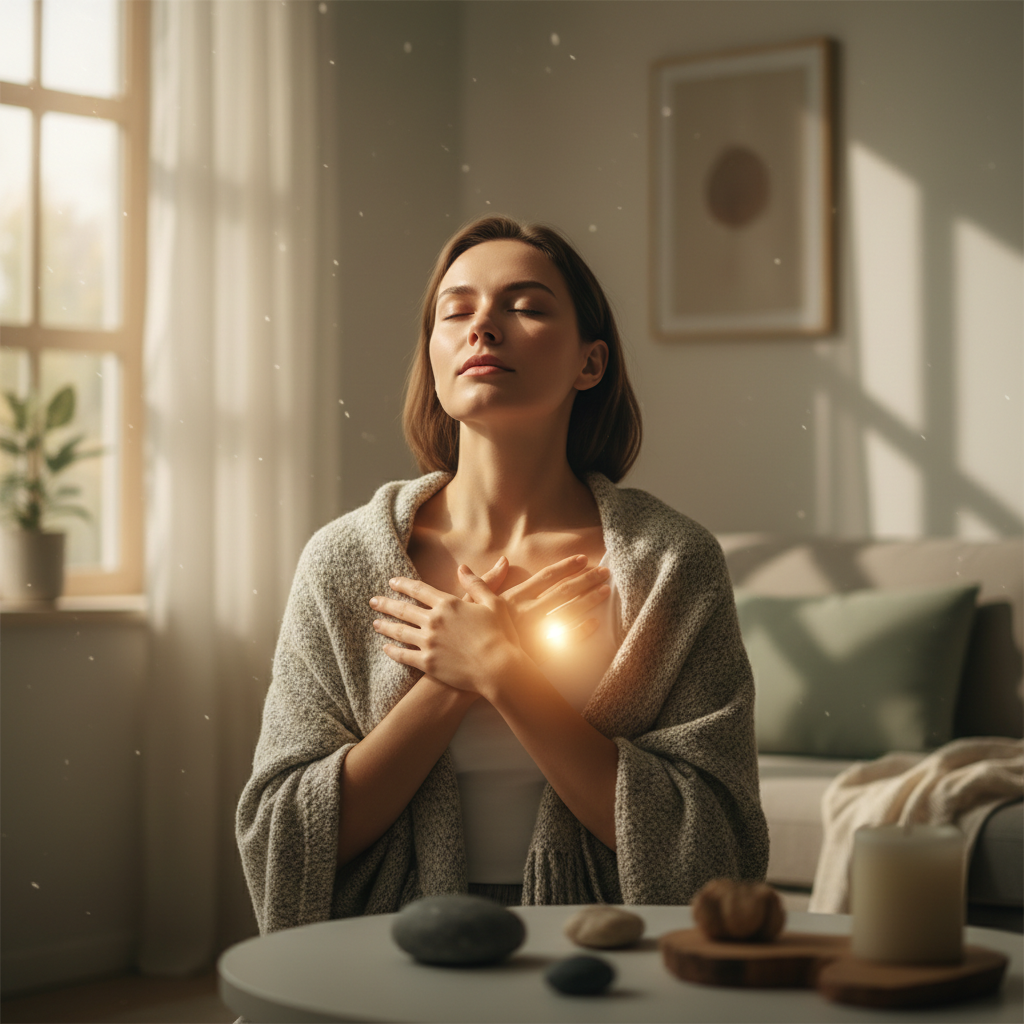
A simple entry point: when anxiety arises, place one hand on your heart and one on your belly. Breathe. Ask gently — what am I actually feeling beneath this? You don't need to fix anything in that moment. You only need to be with what's true.
A Closing Reflection
Reducing anxiety naturally isn't about eliminating discomfort. It's about building the internal capacity to move through discomfort — fluidly, gracefully, with increasing trust in your own system. Every conscious breath, every morning walk, every moment of still witnessing is not a small thing. It is integration in motion. It is the slow, powerful return to yourself.
You were not built to be always calm. You were built to be resilient — to feel fully, to move through sensation, and to return again and again to your own ground.
So here's a gentle invitation: tonight, before you sleep, place your hand on your chest. Take three slow, deep breaths. Let your exhale be longer than your inhale. And simply ask: what does my body most need tomorrow?
Then listen. Not with your thinking mind — but with your whole, embodied, wise self.
Further Exploration
- UMass MBSR Program — The original Mindfulness-Based Stress Reduction program founded by Jon Kabat-Zinn
- Dr. Peter Levine — Somatic Experiencing — Pioneering body-based trauma and anxiety healing work
- Huberman Lab: Tools for Managing Stress and Anxiety — Science-based protocols from Stanford neuroscientist Dr. Andrew Huberman