What if the exhaustion you feel isn't personal? What if the sense that something fundamental is breaking — and simultaneously becoming — isn't anxiety, but perception?
Something is shifting beneath the surface of ordinary life. You can feel it in the news cycle that never seems to resolve. In the loneliness that persists even when you're surrounded by people. In the strange mix of technological wonder and deep unease. In the climate reports that arrive like quiet emergencies we don't quite know how to hold.
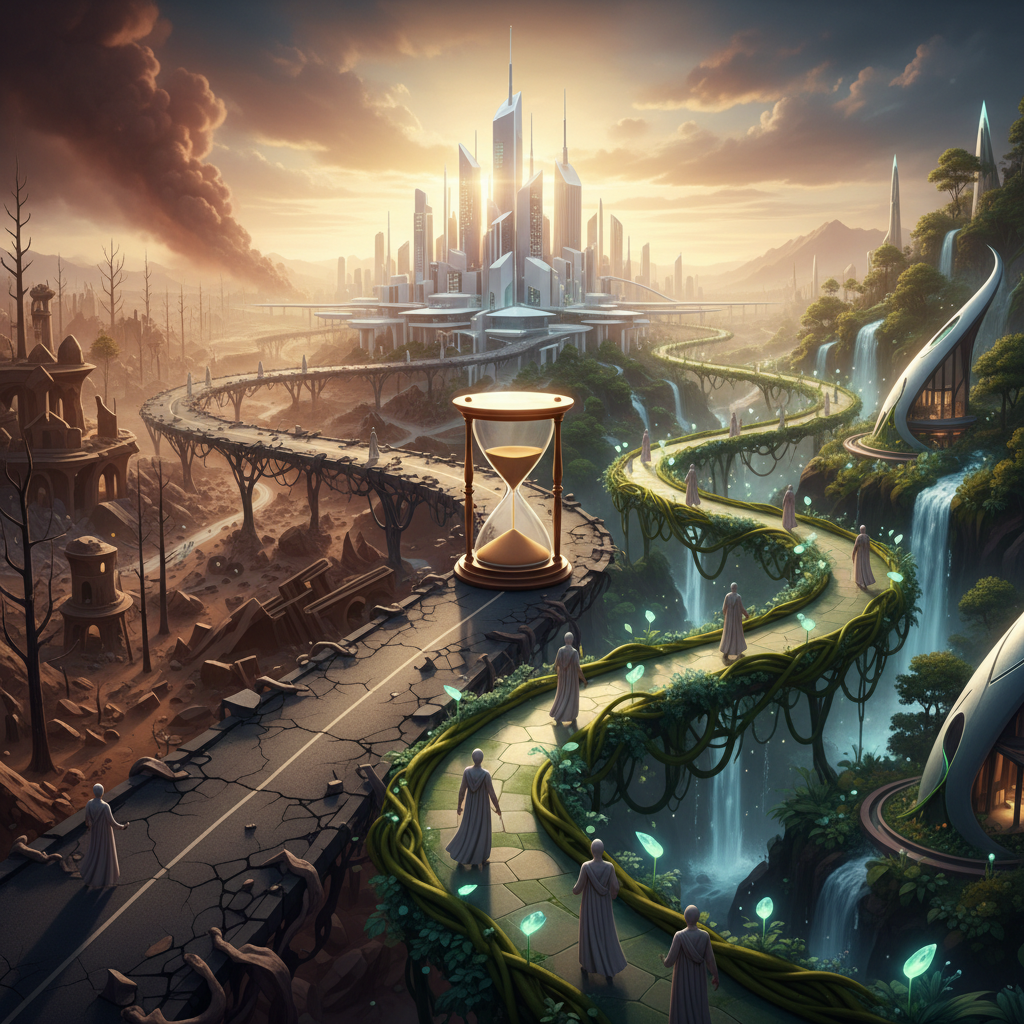
This is not catastrophism. This is clarity. Humanity is standing at a genuine threshold — a civilizational choice point between two futures — and the path forward is not predetermined. It is being shaped, right now, by millions of individual and collective decisions, many of them invisible, many of them yours.
The Fracture Lines Are Real
The word "polycrisis" has entered mainstream discourse — a term used by historians and economists to describe the convergence of multiple, interconnected crises that compound one another in unpredictable ways. Climate instability. Economic inequality reaching levels not seen since the Gilded Age. A global mental health crisis that the WHO describes as pandemic-level. A loneliness epidemic so severe that the U.S. Surgeon General issued a formal advisory in 2023, noting that social disconnection carries mortality risks comparable to smoking 15 cigarettes a day.
These aren't separate problems. They are symptoms of the same underlying fracture: a civilization built on extraction — of the earth, of labor, of attention, of meaning — reaching the natural limits of that architecture.
The old system asked: How much can we take?
The new question is: How deeply can we belong?
"We are living through the most profound transformation in human history. From now on, radical, disruptive change will be our constant companion."
— Jeremy Rifkin, economist and author of The Green New Deal
The Technologies That Mirror Our Inner State
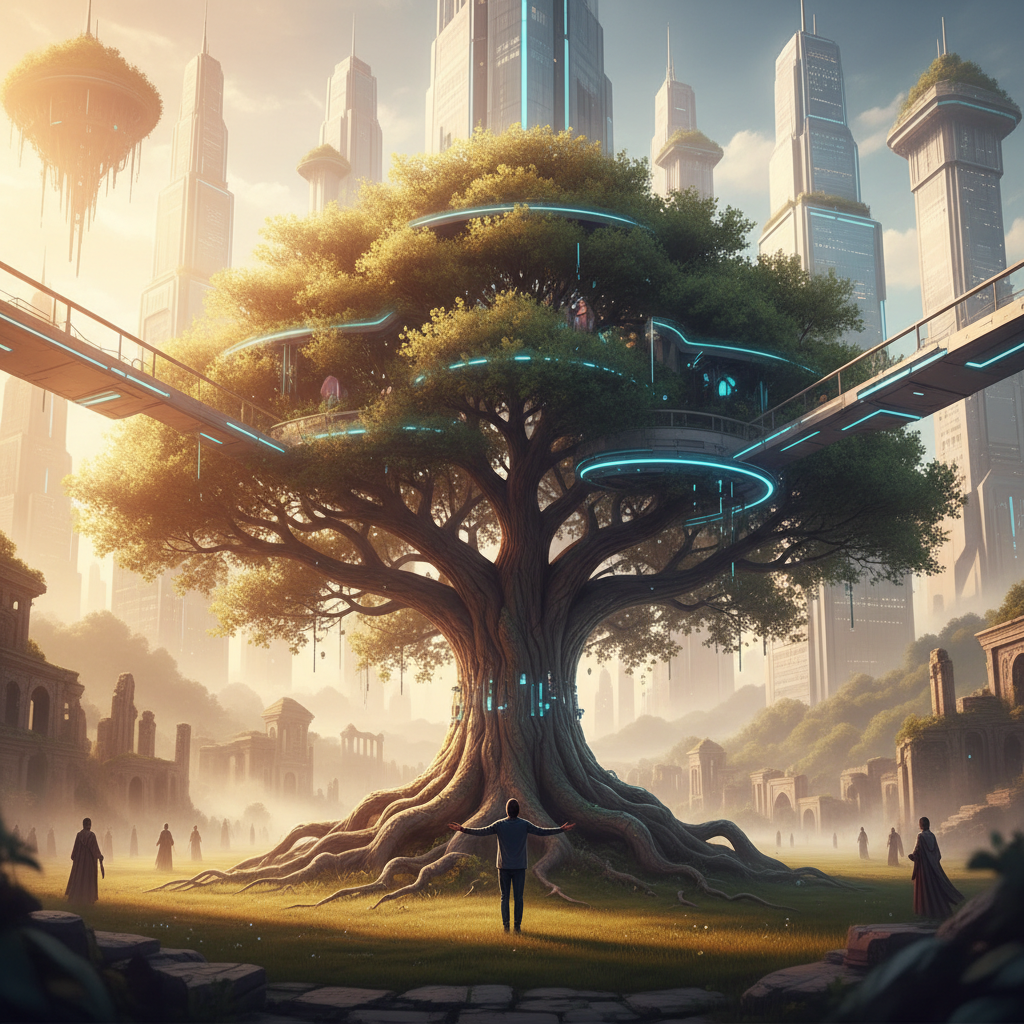
Artificial intelligence has arrived at the center of this threshold moment — not as a neutral tool, but as a mirror. The systems we are building reflect the values, fears, and intentions of the people and institutions that build them. AI trained on surveillance capitalism produces surveillance. AI trained on care produces care. The technology itself is neither savior nor destroyer. It is an amplifier.
This is why the inner work is not separate from the outer work. It has never been more urgent to ask: What are we amplifying? What intentions are we feeding into the systems we create?
Researchers at the Stanford Human-Centered AI Institute have been vocal about the need for ethics, equity, and human flourishing — not efficiency alone — to guide AI development. But institutions only move when the consciousness inside them shifts. And consciousness shifts when individuals do.
This is the thread that runs through everything: the external world is an expanded version of our internal one. What we are collectively is what we collectively create.
Regeneration Is Not a Metaphor
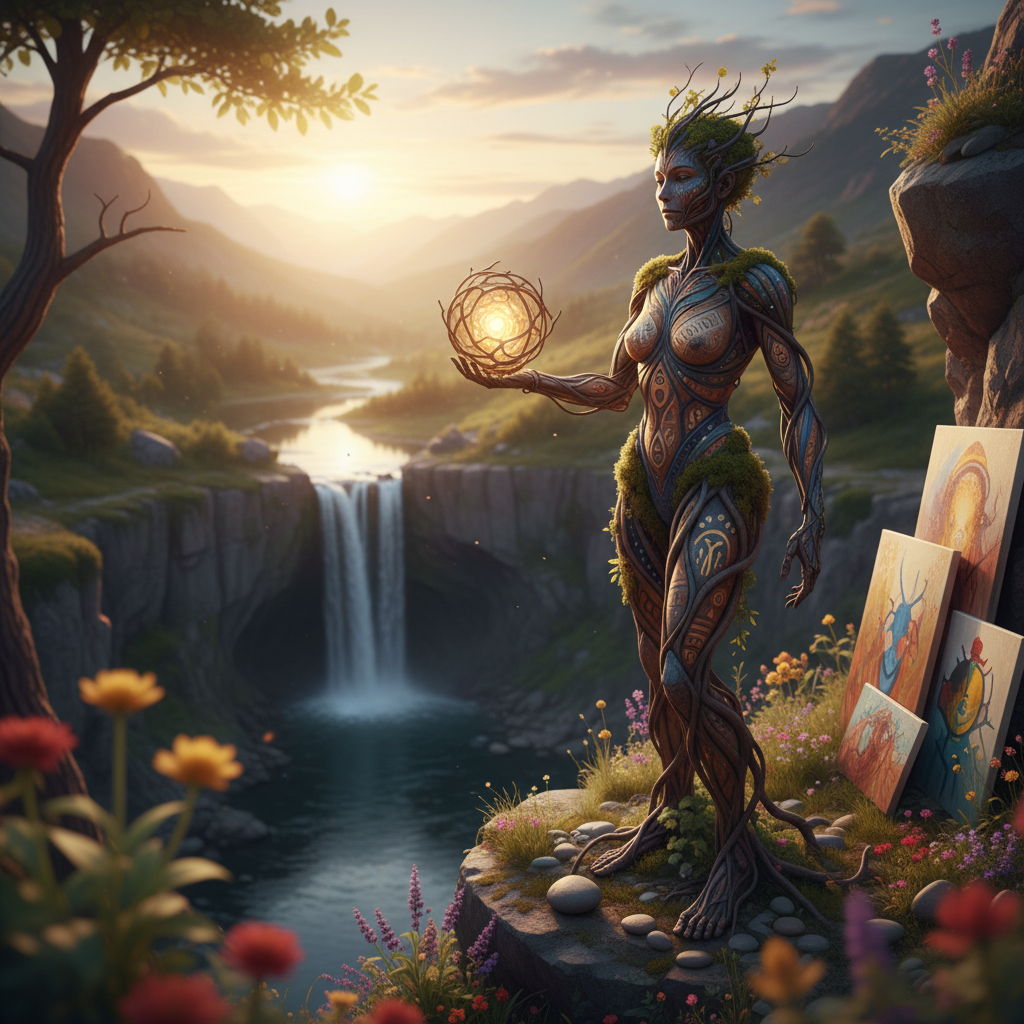
Across ecology, economics, medicine, and community design, a new paradigm is quietly taking root. It goes by different names — regenerative, relational, circular, bioregional — but the underlying pattern is the same: moving from systems that deplete to systems that restore.
In agriculture, regenerative practices are demonstrating that it's possible to feed people while healing the land rather than exhausting it. The Rodale Institute has decades of research showing that regenerative organic agriculture can sequester carbon, rebuild soil biodiversity, and increase long-term yields — all at once.
In economics, thinkers like Kate Raworth are proposing Doughnut Economics — a model that honors both human wellbeing and planetary boundaries, replacing the myth of infinite growth with the wisdom of dynamic balance.
In medicine and mental health, trauma-informed care, somatic practices, and community-based healing are recognizing that the body and its social environment are inseparable. Healing is not individual optimization. It is relational restoration.
Regeneration, at every scale, follows the same principle: nothing is wasted, everything is in relationship, and vitality moves in cycles.
The Spiritual Dimension Cannot Be Skipped
Here is what the data cannot fully capture: there is a spiritual hunger at the core of this moment. Not religious in the institutional sense — though that may be part of it for some — but a hunger for meaning, connection, and sacred belonging that no productivity app or economic policy can satisfy.
The philosopher Charles Taylor called this the crisis of "malaise" in modern life — a hollowness that comes from the erosion of shared meaning and the flattening of existence into transaction. When everything becomes a resource to be mined — including our attention, our data, our relationships — the soul registers the loss.
What is rising in response is something ancient wearing new clothes. A return to presence. To land. To the body. To practices of stillness that remember what cannot be monetized. Meditation, ceremony, breathwork, grief rituals, community care — these are not lifestyle accessories. They are acts of civilizational repair.
To live with Purposeful Presence right now — to bring full awareness to how you spend your energy, where you place your attention, and who you choose to become — is not a small thing. It is a contribution to the collective field.
You Are Not Separate From This Story
It can feel easier to consume the narrative of threshold — to read about it, share the articles, feel the weight — than to genuinely ask: Where am I in this story? What is mine to do?
Not everything is yours to carry. Grandiosity is its own form of avoidance. But something is yours. Some small territory of transformation at the intersection of your gifts, your grief, and what the world genuinely needs. That intersection is worth sitting with.
The mystic and activist Thomas Berry said: "The universe is not a collection of objects, but a communion of subjects." You are not a passive witness to this moment. You are a participant in a living system that is, right now, deciding what it wants to become.
Begin where you are. With your breath. With your choices today. With the quality of presence you bring to the people in your life. With the values you allow to guide your attention.
The threshold is real. And you are standing on it — not in fear, but in the kind of grounded aliveness that knows: this moment matters, and so do you.
A Gentle Invitation
Take a breath. Place one hand on your heart. Ask yourself, without pressure or performance: What is one small way I am being called to move from extraction to care — in my own life, in my relationships, in how I inhabit this world? You don't need to solve everything. You only need to stay awake to the question.