
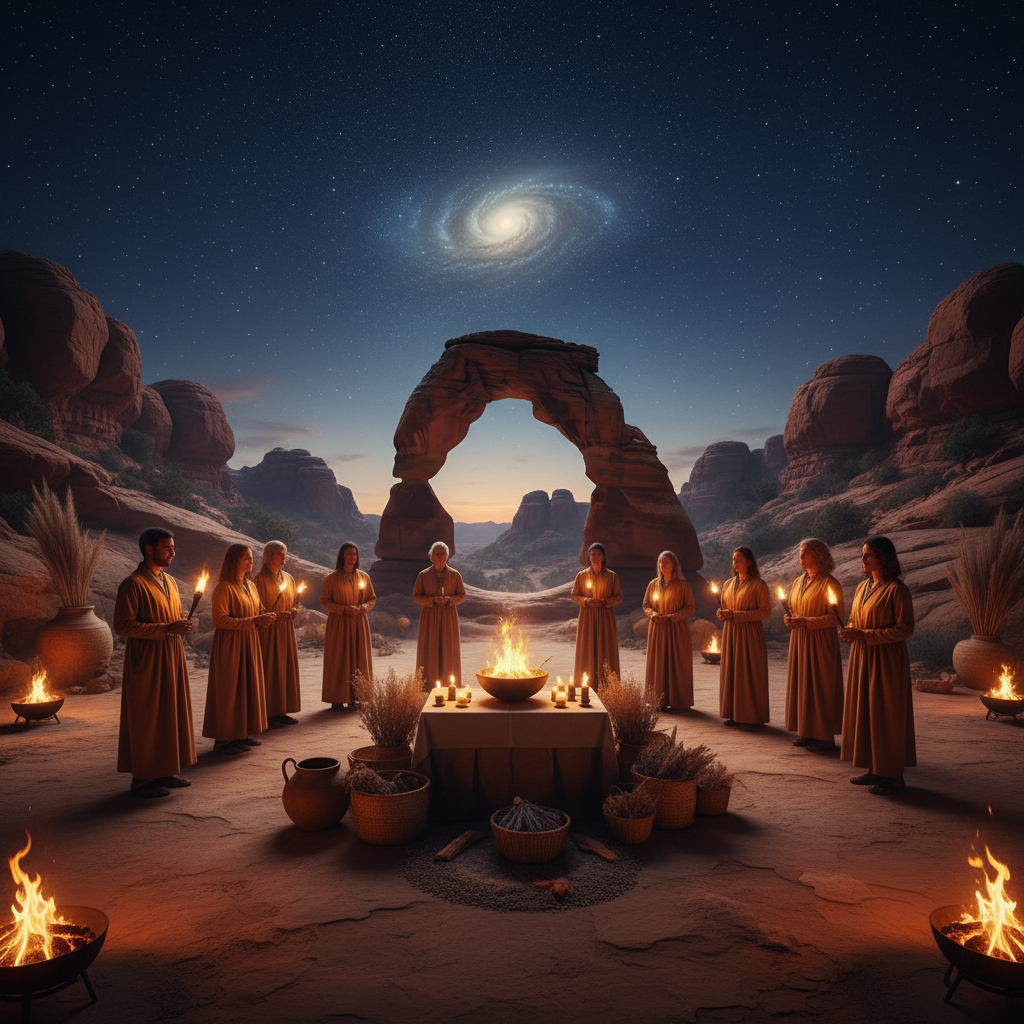
There is a moment — perhaps you've felt it — when something in you knows that who you were yesterday can no longer carry you forward. A door has opened, or closed. A season has ended. And yet the world around you keeps moving as though nothing has changed, offering no ceremony, no witness, no sacred pause to honor the magnitude of what is happening inside you.
This is one of the quiet aches of modern life: we are a species built for initiation, and we are living in a world that has largely forgotten how to offer it.
The Ancient Architecture of Becoming
Across every culture and continent, for tens of thousands of years, human communities understood something we are only now beginning to rediscover through neuroscience and depth psychology: transitions are not just emotional events — they are biological, relational, and spiritual ones. They require a container. A threshold. A conscious crossing.
Anthropologist Arnold van Gennep, in his foundational 1909 work The Rites of Passage, identified a universal three-stage structure woven into initiatory rituals worldwide: separation (leaving behind the old identity), liminality (the threshold — disorienting, sacred, transformative), and incorporation (returning, renewed, with a new role recognized by the community).
Without these stages — without witnesses, without ritual, without community holding the space — we can get stuck. We cross a threshold physically but not psychologically. We become parents without ever grieving the self we were before. We enter adulthood without being received as adults. We lead without being forged by meaningful challenge. We grieve alone, with no elder to tell us: this darkness is not the end of you.
"Without the experience of initiation, many people live in a kind of perpetual adolescence — biologically adult, but psychologically and spiritually still waiting to be seen and called forward."
— Bill Plotkin, depth psychologist and author of Wild Mind
The Thresholds We Are Not Taught to Cross
Think of the great passages of a human life. How many of them were honored — truly honored — with intentional ceremony, community witness, and sacred space?
- Adolescence into adulthood — the awakening of identity, sexuality, and the first encounter with mortality
- Becoming a parent — a complete dissolution and reformation of self, relationship, and purpose
- Grief and loss — the underworld passage that, without initiation, can become an endless loop of unprocessed pain
- Leadership and responsibility — the call to carry others, to serve beyond ego
- Spiritual maturity — the shift from seeking external authority to embodying internal wisdom
Each of these is not merely a life event. It is an invitation into a new self. And when that invitation goes unwitnessed, the psyche often continues to knock — through depression, restlessness, compulsive seeking, or the persistent feeling that something essential is missing.
Research in developmental psychology supports this. Studies published through the APA's Developmental Psychology journal consistently show that structured rites of passage — particularly for adolescents — correlate with stronger identity formation, reduced risk behavior, and greater sense of belonging and purpose. The container matters. The community matters. The naming of the crossing matters.
Liminality: The Sacred Discomfort of the In-Between
The liminal space — that tender, disorienting, threshold state between who you were and who you are becoming — is not something to rush through. It is, in fact, the most sacred territory of any initiatory journey.
Culturally, we have become deeply uncomfortable with liminality. We reach for distraction, explanation, resolution. We want the story to make sense before we've finished living it. But the wisdom traditions — and increasingly, modern trauma-informed psychology — tell us something different: the willingness to not-know, to stay present in the dissolution, is precisely what allows genuine transformation.
Depth psychologist Bill Plotkin's work at the Animas Valley Institute offers practices for what he calls soulcraft — the deliberate use of nature, solitude, dreamwork, and ceremony to support these passages. His approach, rooted in both Jungian psychology and earth-based wisdom, affirms that the psyche does not simply outgrow its old self. It must be consciously, even ritually, released.
This is also supported by the neuroscience of identity and neuroplasticity. When we engage in meaningful, embodied ritual — movement, breath, symbol, community — we create new neural pathways while simultaneously signaling to the nervous system that the old pattern of being is complete. The brain, like the soul, responds to ceremony.
Reclaiming the Ritual: How We Begin Again
You do not need to wait for a culture to offer you what it has forgotten. The impulse toward initiation lives in you already — in every longing for meaning at a turning point, every instinct to mark a moment with something more than a social media post.
Reclaiming initiation in modern life might look like:
- Creating a conscious threshold ceremony at a life transition — with witnesses you trust, intention you've named, and a symbolic act of release and renewal
- Seeking a community of practice — a circle, a cohort, a sangha — who can hold space for your becoming
- Working with a guide or mentor who has crossed the threshold you are approaching
- Spending time in nature and solitude during periods of major transition — letting the natural world mirror your inner movement
- Engaging in somatic practices — breathwork, movement, embodied meditation — that allow the nervous system to process and integrate
Organizations like the School of Initiated Living and the School of Lost Borders offer guided vision fasts and rites of passage rooted in both indigenous wisdom and contemporary psychological understanding. These are real thresholds, held with care.
A Closing Reflection
You have already crossed more thresholds than you've been given permission to honor. Parts of you have died and been reborn, quietly, without ceremony — waiting to be seen.
What would it mean to go back, even now, and offer those passages a moment of sacred recognition? A candle lit. A letter written. A word spoken aloud in the presence of someone who loves you: I am not who I was. And I am ready to be received as who I am becoming.
This is not nostalgia. This is integration. And integration, dear one, is how the wound becomes wisdom — and the crossing becomes a foundation you can actually stand on.
The invitation: Take a few slow breaths. Call to mind one threshold in your life that passed without ceremony. What would it feel like to offer it — even gently, even now — a moment of conscious recognition? You might light a candle. Write a few lines. Or simply close your eyes and say: I witnessed that. It mattered. I have changed.
Further Exploration
- The Rites of Passage by Arnold van Gennep — The foundational anthropological study of initiatory structure across cultures
- Animas Valley Institute — Bill Plotkin's center for nature-based soul work, soulcraft, and modern rites of passage
- School of Lost Borders — Practitioners of the vision fast tradition, offering guided threshold experiences in nature