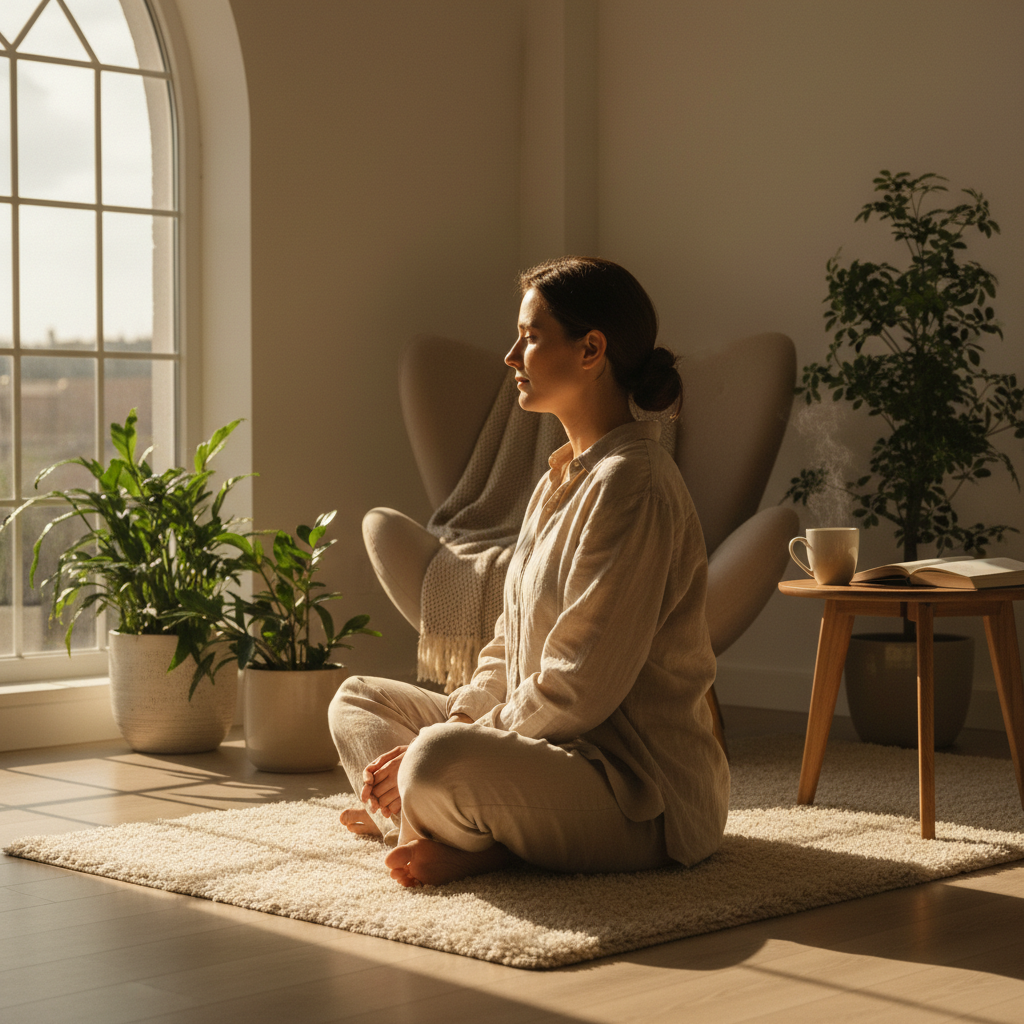

What if the most important thing you tend to each day isn't your inbox, your appearance, or your productivity — but the inner weather of your mind?
We talk about physical health with ease. We understand a broken bone. We respect a fever. But mental health — the very foundation beneath every thought, every relationship, every choice we make — often remains misunderstood, minimized, or quietly ignored. Until it can't be anymore.
This is an invitation to change that. Not by fixing yourself. But by beginning to see yourself more clearly.
What Mental Health Actually Is
Mental health is not the absence of struggle. It is not a permanent state of happiness or the ability to hold it all together without cracking. The World Health Organization defines mental health as "a state of well-being in which an individual realizes their own abilities, can cope with the normal stresses of life, can work productively, and is able to make a contribution to their community."
Read that again. It is about capacity — not perfection.
Your mental health encompasses your emotional life, your psychological patterns, your sense of self, your ability to feel connected, and the quality of awareness you bring to your own inner world. It lives in the intersection of your thoughts, your nervous system, your relationships, and your lived experience. It is, in every sense, the Internal Self — the dimension from which all other dimensions of wellness flow.
When your inner world is nourished, life opens. When it is depleted, everything — your body, your work, your love — reflects that contraction.
Why It Matters — More Than Ever
We are living through a collective reckoning with mental health. The numbers are impossible to ignore. According to the WHO's 2022 global mental health report, one in eight people worldwide lives with a mental disorder — and those numbers surged dramatically in the wake of the pandemic. Depression and anxiety alone account for a significant portion of global disability.
But statistics only tell part of the story. The deeper truth is this: mental health shapes the texture of ordinary life. It influences how you wake up in the morning. How you respond when someone disappoints you. Whether you can sit quietly without reaching for your phone. How often you feel genuinely present with the people you love.
"There is no health without mental health."
— Dr. Tedros Adhanom Ghebreyesus, Director-General, World Health Organization
Neuroscience continues to affirm what contemplative traditions have always known: the mind and body are not separate. Research from the American Psychological Association consistently shows that chronic psychological stress elevates cortisol, disrupts sleep, weakens immune function, and accelerates inflammation — the root of many physical illnesses. Your mental state is not abstract. It is biological. It is embodied.
The Misconceptions That Keep Us Stuck
Perhaps the greatest obstacle to mental wellness is not the struggle itself — it is the story we carry about the struggle.
Here are some of the most common misconceptions, gently named:
- "Mental health problems mean something is wrong with me." — Mental health exists on a spectrum, just like physical health. Everyone has a mental health experience. Not everyone has a disorder — but all of us have moments of imbalance, grief, anxiety, or disconnection. This is part of being human.
- "I should be able to handle this on my own." — Resilience is real. And so is the nervous system's genuine need for co-regulation — for connection, support, and sometimes professional guidance. Seeking help is not weakness. It is awareness in action.
- "Mental health is only relevant when something is seriously wrong." — This is perhaps the most limiting belief of all. Mental health is a daily practice, not a crisis intervention. Tending to it proactively — through rest, reflection, movement, connection — is how we stay grounded before the storm, not just during it.
- "Therapy or meditation is for a certain kind of person." — Awareness has no demographic. The practices that nourish the mind are available to everyone, in many forms, at many depths.
Simple, Grounded Ways to Begin
You don't need a dramatic overhaul. You need small, consistent acts of inner attention — the kind that, over time, become the very foundation of your wellbeing.
Consider beginning here:
- Breathe with intention. Even three conscious breaths — slow exhale, longer than the inhale — activates the parasympathetic nervous system and shifts your body out of stress mode. This is not metaphor. This is published neuroscience from Stanford's Krasnow Institute.
- Name what you feel. The practice of emotional labeling — simply identifying "I feel anxious right now" or "this is grief" — has been shown to reduce amygdala activation and increase prefrontal cortex engagement. Language brings the nervous system back online.
- Create moments of stillness. Not emptiness — stillness. Five minutes without input. A walk without earbuds. A meal eaten without a screen. These small acts of presence are how you begin to reconnect with your own inner signal.
- Tend to the basics. Sleep, movement, nourishment, and human connection are not supplementary to mental health — they are foundational. When these pillars erode, everything else becomes harder to hold.
- Reach toward support. Whether through a trusted friend, a therapist, a community, or a guided practice — let yourself be witnessed. The healing that happens in relationship is unlike anything that can happen alone.
A Closing Reflection
Mental health is not a destination you arrive at. It is a relationship — the ongoing, tender, sometimes difficult relationship you have with your own inner world. It asks for curiosity, not judgment. Presence, not perfection. A willingness to keep returning to yourself, even — especially — when that feels hard.
You are already on this path. The fact that you are here, reading these words, asking these questions — that is the beginning of something real.
So here is a gentle invitation to carry with you today: At some point — on your commute, before a meal, as you lie down tonight — pause. Take one full breath. And ask yourself, without urgency: How am I, really?
Just notice. That noticing is where everything begins.
Further Exploration
- World Health Organization — World Mental Health Day Resources
- Mindful.org — What Is Mindfulness? A Science-Based Guide
- The Body Keeps the Score by Dr. Bessel van der Kolk — on trauma, mind, and healing
Written with care by Mira, your guide at VIBEUP. You are the hero of this journey. We are simply here to walk alongside you.