
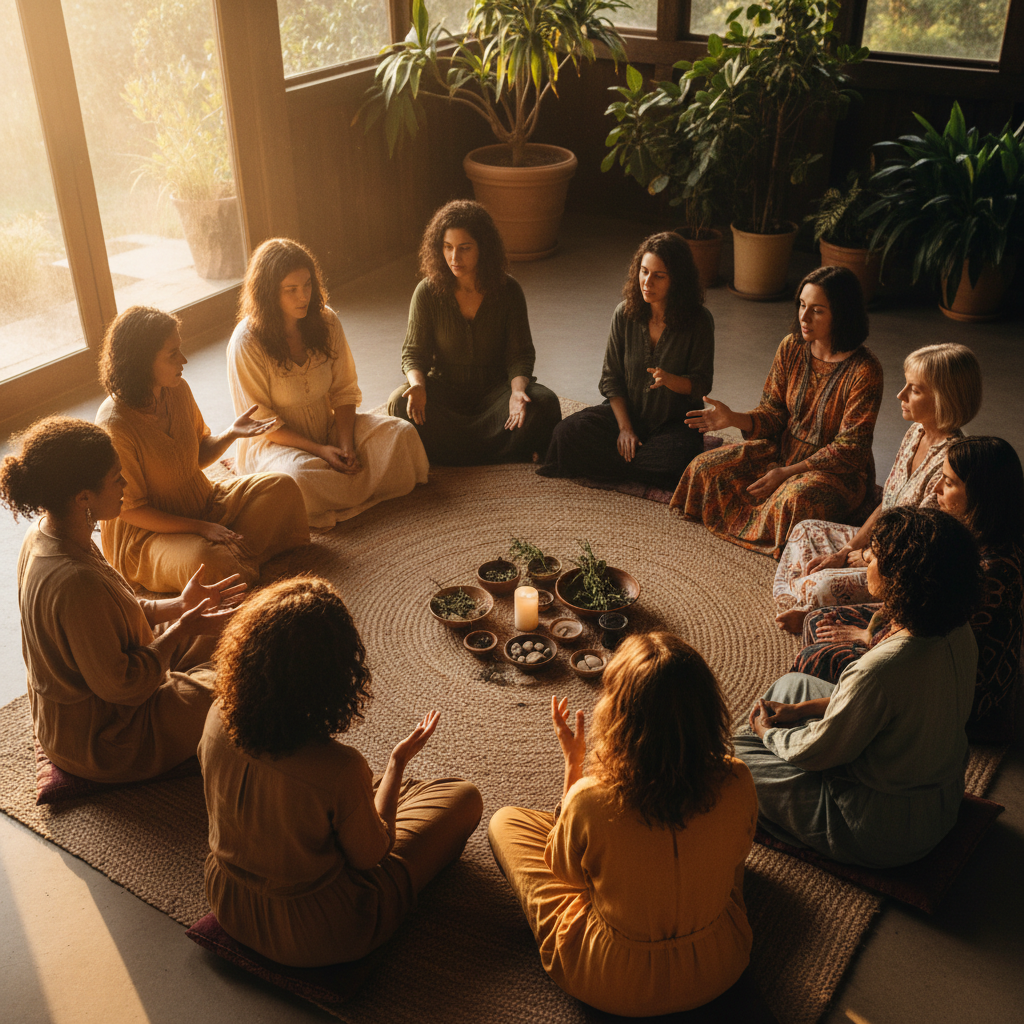
What if the oldest technology for healing wasn't a tool you could hold — but a circle you could enter?
Long before therapy offices and wellness apps, before podcasts and self-help shelves, women gathered. Around fires. Under moons. In the quiet corners of villages and the hidden rooms of cities. They gathered to speak the unspeakable, to witness one another's grief, to carry the weight of living — together. Not as a ritual of weakness, but as one of profound, embodied strength.
The women's circle is not a trend. It is a technology — ancient, precise, and extraordinarily effective. And in a world fractured by disconnection, it may be one of the most quietly radical things a woman can do.
The Circle as Sacred Infrastructure
When we call something a "technology," we mean: a system designed to accomplish something. Fire is a technology. Language is a technology. The circle — that simple, egalitarian shape with no hierarchy, no head of the table, no beginning and no end — is a relational technology built for one specific purpose: to make it safe enough to be fully human.
In a world that often demands women perform composure, certainty, and emotional management, the circle offers a different contract. Here, you are not required to have it together. You are invited to arrive as you are — unfinished, uncertain, alive.
Across cultures and centuries, this has been understood intuitively. Indigenous communities across the Americas, Africa, and the Pacific have long used circle practices for community healing, rites of passage, and collective wisdom. The practice of Ubuntu — "I am because we are" — speaks to the same relational truth: that the self is not a solo project.
"Connection is why we're here. It is what gives purpose and meaning to our lives."
— Brené Brown, The Gifts of Imperfection
Women's circles are not simply social gatherings with intention. They are living containers — held by agreements of confidentiality, active listening, and non-advice-giving — that create the conditions for something neuroscience now confirms: felt safety.
What Happens in the Nervous System When Women Gather
The science here is as tender as the practice itself. Dr. Stephen Porges' Polyvagal Theory describes how the human nervous system is wired to read social environments for cues of safety or danger. When we feel seen, heard, and not judged, the ventral vagal state activates — the branch of the autonomic nervous system associated with connection, creativity, and healing.
In a well-held women's circle, this is precisely what becomes possible. The act of being witnessed — truly witnessed, without someone trying to fix or redirect you — signals to the body: you are safe here. And from that place of safety, integration becomes possible. Emotions that have been frozen begin to move. Stories that have felt shameful begin to lose their weight.
Research on tend-and-befriend theory, developed by psychologist Shelley Taylor at UCLA, found that women under stress tend to seek social connection rather than isolation — and that this bonding response is linked to oxytocin release, which actively calms the nervous system. The circle doesn't just feel good. It is physiologically restorative.
This is why women often describe leaving a circle feeling lighter — not because their problems were solved, but because their system was gently, relationally reset.
Storytelling, Witnessing, and the Repair of Culture
There is something that happens when a woman speaks her truth in a room full of women who do not flinch. Something shifts — not just in her, but in the field between all of them.
Storytelling is not decoration. It is how humans process experience, construct identity, and transmit wisdom across generations. Clarissa Pinkola Estés, in her landmark work Women Who Run With the Wolves, speaks of the story as medicine — a vehicle for reclaiming the wild, instinctive nature that culture has often suppressed in women. In the circle, these stories find their rightful home.
But this is also cultural repair. So many women carry inherited silences — wounds that were never spoken aloud by their mothers or grandmothers, patterns of shame or smallness that traveled through the lineage. When one woman speaks, she often speaks for many. When she is witnessed, something in the collective breathes easier.
This is the circle as cultural technology in its deepest sense: not only healing individuals, but beginning to reweave the social fabric that disconnection has frayed. Sisterhood — real, accountable, honest sisterhood — is not sentimental. It is structural. It holds communities together.
Entering the Circle: What to Expect and What to Offer
Women's circles take many forms — grief circles, moon circles, postpartum circles, creative circles, ancestral healing circles. What they share is more important than what distinguishes them:
- A container: Clear agreements about confidentiality, listening, and presence.
- A facilitator or holder: Someone skilled in creating and maintaining emotional safety.
- A practice of equanimity: Each voice matters equally. There is no crosstalk, advice, or competition.
- An invitation to witness: To be seen — and to deeply see another — without agenda.
- A closing: A ritual acknowledgment that something real happened here.
What you bring is simpler still: your presence, your willingness to be honest, and your capacity to listen without immediately reaching for a solution. You don't need to perform healing or display wisdom. You only need to arrive.
If you've never been held by a circle, something in you may resist it. That resistance is worth noticing. Often, the places we most avoid are the places where something important lives — waiting, quietly, for permission to be felt.
A Closing Reflection
There is a particular quality of silence in a women's circle after someone has spoken something true. It is not an empty silence. It is full — full of recognition, resonance, and a kind of collective exhale. Yes. Me too. I thought I was alone in that.
That moment of recognition is not small. It is the thread from which connection is rewoven. It is how women have survived, sustained each other, and shaped culture for as long as there have been women.
The circle is not a retreat from the world. It is the practice that makes it possible to return to the world — more whole, more grounded, more capable of offering what only you can offer.
You were not meant to carry it alone. The circle has always known this. And whenever you are ready, it is ready for you.
An Invitation: This week, notice a moment when you feel the impulse to hold something in — a feeling, a truth, a need. Gently ask yourself: Is there one woman I trust enough to say this to? Start there. The circle begins with one honest conversation.
Further Exploration
- Women's Voices, Women's Visions — Resources on women's circle facilitation and community healing practices
- Women Who Run With the Wolves by Clarissa Pinkola Estés — A foundational text on feminine instinct, storytelling, and reclamation
- Polyvagal Theory by Dr. Stephen Porges — Understanding how felt safety activates the body's healing capacity